01/08/25
Ximai
hackmyvm
بِسْمِ اللَّهِ الرَّحْمَنِ الرَّحِيمِ
Hello! It’s been a while since my last writeup but as always, we’re continuing with HackMyVM machines. This time, we’re tackling a medium-difficulty box named "Ximai". Let’s jump right in.
Recon
We’ll start with some basic reconnaissance using Nmap to identify open ports on the target machine:
The scan revealed the following open ports: 22, 60, 3306, and 8000.
- Port 22: Likely SSH
- Port 3306: Indicates a MySQL database might be exposed
- Port 8000: Web service
- Port 60 : No idea
After checking out port 8000, I discovered it was running WordPress. I initially ran wpscan to check for known vulnerabilities, but it didn’t return anything useful on the first attempt.
Next, I visited the default site hosted on port 80, which turned out to be the default Apache page.
Directory
It's common for some creators to hide directories behind this kind of placeholder, so I decided to run Gobuster to enumerate potential hidden directories.
While exploring the hidden directories, I discovered two interesting files: info.php and reminder.php.
The info.php page displayed the typical PHP info page, which could potentially leak server configuration details (useful for later exploitation).
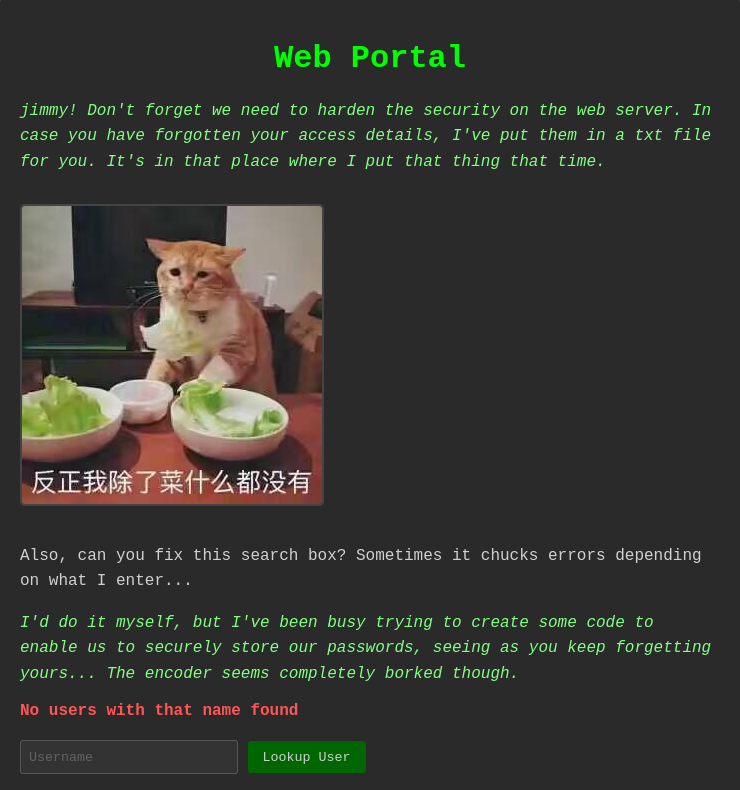
The reminder.php page contained a cat image, but the image path seemed unusual:
Now we found another accessible hidden directory, which might lead us further toward exploitation.
Wordpress Vulnerability (CVE 2025-2011)
After some light fuzzing on the previously discovered directory, I managed to uncover credentials for a user named jimmy. However, the challenge now was figuring out how to leverage or read those credentials effectively.
I decided to revisit the WordPress instance running on port 8000 and perform another scan using WPScan — this time including the --api-token (which you can get from the official WPScan website) to enable latest vulnerability detection.
After researching the CVE found by WPScan, I came across a GitHub repository containing a proof of concept (PoC):
Instead of using the full exploit script, I extracted just the payload and adapted it for use directly through MySQL, simplifying the process and tailoring it to the context of this machine.
sqlmap -u "http://wordpress.local:8000/wp-admin/admin-ajax.php?s=test*&perpage=20&page=1&orderBy=source_id&dateEnd=&dateStart=&order=DESC&sources=&action=depicter-lead-index" --file-read /etc/jimmy.txt
After successfully reading the /etc/jimmy.txt file, I obtained the credentials for the user jimmy , giving us a potential foothold on the system.
Initial access
authenticate as User jimmy
After logging in as jimmy, I found myself in a restricted shell environment. This type of shell limits the commands a user can execute, preventing typical system interaction.
I began running some basic and random commands (such as ls, cd, cat, etc.) to observe which ones were allowed and which were blocked.
While testing commands within the restricted shell, I discovered that only a few basic commands were allowed — specifically, cd and echo.
Since echo was one of the few available commands, I used it to inspect the PATH environment variable, which defines the directories the shell searches for executable commands.
After checking the PATH variable using echo $PATH, I noticed that it was broken or misconfigured — meaning standard commands couldn’t be executed unless full paths were provided. This gave us two possible paths forward:
first one is :
we can regain access to basic system commands:
or command execution via absolute paths:.
Priv Escalation
the first thing we can do is to read wp-config.php file by :
Inside the wp-config.php file, I found a second set of credentials belonging to a user named adminer. This suggests that the user might have a local account on the system or that the credentials could be reused elsewhere.
we authenticate as adminer .
I checked sudo privileges to see if the user had any elevated permissions:
no matter how many variations I tried, the output remained the same, and I couldn't locate the flag.
While continuing enumeration, I discovered that the grep binary was writable by the current user — an unusual and critical misconfiguration. To exploit this, I simply replaced its content with a Bash shell:
**Fun Fact:**I actually tried to skip the whole jimmy user process by directly exploiting the SQL injection in the WordPress plugin to read the wp-config.php file… but the creator was Tricky too for that!
ROoteD